
JIAYI ZHU
Teaching and Learning Events
1. The Photographers' Gallery tour with Chrystel Lebas
During this tour, I saw the work Tap and Touch Cinema by performance artist VALIE EXPORT, which challenges the public's view of women's bodies and boundaries. In 1970, EXPORT stood on the street and invited strangers to put their hands into a box in the chest area of her clothes and touch it. This behavior regarded the body as a "living movie screen" and exposed people's objectification and social perspective on women's bodies. EXPORT's work has triggered a profound discussion about body autonomy, gender and viewing behavior. At the same time, it also inspired me to invite strangers to hug, and explore the deep emotions of interpersonal relationships by establishing physical contact with strangers. EXPORT puts herself in a public state that allows strangers to touch, showing the openness of the body in art. Her work makes me rethink the way the body is used and the social meaning of touch, and the hug experiment is my continuation of this thinking. I want to gain the importance of hugs or touch in relationship building by showing how to establish instant connections between people through simple hugs.
2. Exhibition Crits with Dafna Talmor and Mervyn Arthur
During this crit, I received many valuable suggestions. In terms of installation, there were many feasible approaches, such as varying the hanging height of the dresses and installing them in a more scattered arrangement. However, due to the installation limitations of the space, these ideas couldn’t be realized. Fortunately, I had the opportunity to implement them in the subsequent Milbank exhibition. There were also many questions raised about the content, such as the way the hugs should be performed and the distance between the participants. Additionally, the choice of venue was discussed; perhaps more intimate settings could have been considered. I had thought about this when choosing the shooting locations, but due to the limitations of cyanotype exposure conditions, I was unable to experiment in indoor spaces, thus missing out on many opportunities for private settings. However, I believe this limitation can be addressed through other means, such as using ultraviolet lighting. The choice of dress has also been a point of ongoing indecision for me. Whether to use dresses, t-shirts, or other types of clothing, or even choose a different style for each piece. I’ve considered the guiding influence this could have, and I didn’t want the audience to be distracted by the variety of clothing styles and miss the core message I wanted to express. Additionally, clothing could potentially imply certain identities. If it might cause misinterpretation, I’d rather just be myself. As I’m a woman, I chose the simplest white dress, aiming for a more pure and purposeless approach to the experiment. This discussion has brought me new perspectives, and I’ve realized the infinite possibilities of this project. There are still many aspects to develop and improve, and many deeper meanings to explore.


3. Millbank Residency
During the residency at Milbank, I tried to curate an exhibition with my team members. The name of the exhibition was Interwoven Relationships. We worked together to determine the theme, exhibited works and division of labor, make posters and copywriting, arrange works, promote on social media, make ticket platforms and posters, as well as exhibition equipment and technical support and fund coordination. We also organized private show and organized crits for all residency after the exhibition. This experience has benefited me a lot.
First of all, it is the experience of teamwork. Each of us plays to our strengths, and when determining the location of the works, we determine the exhibition method of each work based on the overall effect instead of individual decisions. This made me fully understand the huge and detailed work content of the curator in the exhibition and all the overall considerations for the scheduling of works. It was the first time I realized that an exhibition requires such a large amount of work content and detail control.
In this exhibition, I exhibited four works about thinking about relationships. I tried some presentation methods that I had never tried before. I tried some presentation methods that I had never tried before. Among them, the three-unit work 20 minutes in sunlight was the most rewarding. Due to the limitation of the venue and other practical factors, I did not use the original plan during the summer show, but hung all the skirts on a rope and exhibited them in parallel. At the Milbank venue, I realized the original exhibition plan. I fixed the rope on the ceiling to hang the skirts at irregular heights and randomly hung the skirts in different directions. It partially blocked the projection, so that the audience had to go through the skirts to enter and watch, reflecting the privacy of the relationship. The skirts were hung at different heights and angles, forming a three-dimensional spatial effect, adding to the visual level of the exhibition, allowing the audience to appreciate the work from multiple angles. The random orientation and distribution of the skirts emphasized the instantaneousness of the hug and the uniqueness of each hug. The audience can feel the different emotional moments carried by each skirt, enhancing the interactive experience. This hanging method is closer to the real contact situation, allowing the audience to "walk into" the skirts and feel the warmth brought by the hug and the integration of personal space.


Interwoven Relationships 2024
Milbank 30, London, England


Group Crits after the exhibition
4. Tutorial with Chrystel Lebas
During the Summer Show, I was always torn about whether or not to place an explanation of my work alongside it. Some audience members had given me feedback saying they needed an explanation. I often saw people walk over, glance at my piece, and then move on. But when I explained it to certain viewers, they suddenly understood and told me, "You should explain it." Since many people are unfamiliar with cyanotypes, they find it hard to understand the process behind my work.
I discussed these concerns with Chrystel, who told me that I don’t need to explain my work—those who are interested will form their own interpretations, and if everything is explained, it loses some of its meaning. While curating at Millbank, I also received suggestions from peers in curation that I could create a process video to explain the origin of the piece. I decided to try it out at Millbank and added an explanation on the last day of the exhibition to observe the effects and differences. I suddenly realized that this approach detracted from the experience—people focused on the explanatory content rather than the work itself, and I found myself limiting the audience’s understanding and imagination.
The suggestions from viewers and curators reflect their needs, and that’s perfectly valid. However, as artists, our goal is not to explain our work but to let it exert its own vitality and continue its story. In this way, leaving room for ambiguity can be powerful. It allows the artwork to take on a life beyond what we, as creators, initially imagined. By stepping back, we invite viewers to bring their own interpretations, questions, and reflections, making the experience more personal and resonant. When an artwork is open-ended, it can spark curiosity and engagement, inspiring viewers to spend more time with it, exploring its layers and even seeing things we might not have noticed ourselves.
I recently came across an interview with Xu Xiaohu, where she suggested that people should experience art without first consulting interpretative guides. She believes that engaging with art is similar to eating or drinking—you’ll naturally know if you like it or not. The same applies to art: sometimes, if a piece doesn’t resonate or seems hard to understand, we might feel like it's our fault. However, it’s really no different from tasting food. The focus should be on your own experience and feelings.
This perspective resonates deeply with me, emphasizing that art appreciation is an instinctive, personal journey. Just as we trust our senses to enjoy a meal, we should trust our feelings and intuition when encountering art. The real essence lies not in deciphering a “correct” meaning but in embracing our immediate responses. By allowing ourselves to engage with art freely, without overthinking, we can form genuine connections and enjoy the unique personal insights that arise naturally.
Reflecting on this,I really understand why Chrystel gave such a suggestion.She also shared with me how surprised she was when she went to the exhibition and saw a book with no text explanation but only pictures. I realized that the vitality of an artwork comes from the space it creates for others to project their thoughts and feelings onto it. The energy of the piece is not diminished by a lack of detailed explanation; rather, it’s enhanced by allowing the artwork to become a dialogue rather than a monologue. This exchange, where the viewer's perspective is as important as the artist's, is what I want my work to inspire. Ultimately, an artwork’s “life” continues in the minds and hearts of those who engage with it, shaping new meanings that extend far beyond my original intentions.


5. Ual Showcase
I also created a showcase through UAL’s platform to display my work. It’s an online gallery that provides us with an opportunity to present our creations. As UAL is a renowned institution, this platform allows more artists to discover my work, making it a great opportunity for me.

ARTISTS OF INTEREST


Tino Sehgal's artistic practice often involves live interactions between participants and the audience, creating what he refers to as "constructed situations." These are dynamic, experiential environments where meaning and engagement are shaped through direct interaction rather than static presentation.The emphasis on improvisation, interaction, and the immediate moment invites the audience to participate in the creation of meaning and experience, highlighting the fleeting and ephemeral nature of the artwork.

Her work exposes private behaviors, like kissing, in public spaces, challenging boundaries between the personal and public. She explores whether public kissing is seen as flaunting and how it influences perceptions of space. By questioning who kisses and where, she examines the tension between private acts and social norms, prompting reflection on identity and individual expression.
In Imponderabilia, Abramović and Ulay stood face-to-face, naked, at the entrance of an Italian museum, forcing the audience to pass through the narrow space between them. This setup compelled each viewer to unconsciously choose which artist to face, and through their body, perceive the presence of the other.


Every day during 2010, Laurel Nakadate photographed herself crying. She undertook this disciplined ritual alone, mostly in private spaces (such as her New York apartment, hotel rooms, and cars), but also in the anonymity of some public spaces (airplanes and ferries, for example).
In this piece, a cheerful woman in a flowing dress strolls confidently down a street, accompanied by a soft, rhythmic soundtrack. The image is interspersed with visuals of the striking red-hot poker flower. The playful atmosphere of the scene is momentarily interrupted when the woman, swinging a flower in her hand, suddenly turns and uses it to smash the windows of parked cars. After a brief pause, the music resumes, and the woman continues her walk, restoring the carefree mood.

READING / EXHIBITIONS


Herder on humanity and cultural difference : enlightened relativism
By Sonia Sikka 1963 1963-.


Marina Abramović in Royal Academy of Arts
23 September 2023 - 1 January 2024


YOKO ONOMUSIC OF THE MIND
15 February – 1 September 2024


The Photographer's Gallery
Marina Abramović, Yoko Ono and Valie Export are performance artists who have profoundly influenced my artistic practice, each in unique and inspiring ways. Their innovative approaches to art and expression have encouraged me to explore new boundaries in my own work, particularly in the realms of physicality, intimacy, vulnerability, and human connection.

Capturing the moment in Tate
13 June 2023 – 28 April 2024


BA Photography Exhibition in LCC
17 May 2024


OFFPRINT LONDON in Tate
17 MAY 2024 - 19 MAY 2024


Peckham 24 in Copeland/ Artists Talks
19 May 2024


In the process of expanding on the Unit 2 project, I studied numerous feminist works. In these pieces, artists use nuanced approaches to convey female perspectives, identity, and social issues, and their expressive techniques have greatly inspired me. The emotions, narratives, and implicit power revealed in their work have made me pay closer attention to the details and symbolic meanings behind each piece.
ACTS OF RESISTANCE: PHOTOGRAPHY, FEMINISMS AND THE ART OF PROTEST
8 MAR - 9 JUN 2024


RCA 2024
20 June – 4 August 2024



Slade School of Fine Art - 2024 Degree Show
8–16 June 2024
Goldsmiths MFA Fine Art
11 July 2024
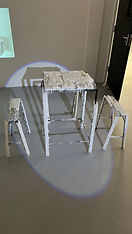
Visiting art exhibitions at other schools has helped me gain insight into commonly used media and diverse modes of expression, while also exposing me to various innovative ways of combining materials.


Hiroshi Sugimoto in Southbank Center
11 Oct 2023 – 7 Jan 2024