
JIAYI ZHU





Video : 20 Minutes in Sunlight
Colour, stereo, dimensions variable
Performance
6*20 min. loop

Video installation
Colour, stereo, dimensions variable
6*20 min. loop
Dress material : cotton
Cyanotype


MA Fine Art Summer Show 2024
Camberwell College of Arts, London, England

Interwoven Relationships 2024
Milbank 30, London, England


94cm*35cm
95% Polyester, 5% Elastane
Cyanotype


Details
In the process of exploring family relationships, I have been searching for a suitable metaphor to express my understanding. I started with crayons, believing that their fragility, along with their ability to be reshaped under heat, serves as an apt metaphor for the father-daughter relationship. Through adaptation, understanding, and even conflict, a new balance can be reached. In this reshaping, the relationship is not simply restored to its original form but instead molded into a new shape. Just as melted wax can take on different forms, the father-daughter relationship evolves and deepens over time and through experiences.
However, when extending this to the mother-daughter relationship, the ideas of breaking down and rebuilding no longer resonate with my understanding. Due to the lack of physical expression from my mother during my childhood, I have chosen the act of hugging as a starting point, seeking to explore how the absence of this physical connection has influenced the development of my own personality.
I decided to capture a hug to experience the part of me that feels absent. When considering how to document this hug, I first thought of clothing. With a background in fashion design during my undergraduate studies, I developed a deep understanding of clothing. As an item that accompanies us daily, clothing is almost like a close companion, and its soft nature allows it to conform closely to our bodies. In my undergraduate research on fabrics, I experimented with combining them with cyanotype printing. By transforming clothing into a camera of sorts, I could create a complete record of the hug's shape and warmth.
In the second unit of my practice, while creating cyanotypes through hugging, I found that a standing form couldn’t ensure that all cyanotype solution received adequate UV exposure. Therefore, I needed to find the most effective exposure ratio that would produce clear results in the shortest possible time. I primarily focused on researching the optimal ratio for combining cyanotype solution with fabric, including the color effects after adding gelatin, as well as appropriate washing methods for the treated fabric.


I conducted comparative experiments based on the following variables and came to the following conclusions after reviewing the literature:
1. Proportion
When the ratio of potassium ferricyanide is higher, the image presents a deeper blue color, while enhancing light resistance and stability. However, the image details may not be as sharp as with the standard ratio.
When the ratio of ferric ammonium citrate is higher, the blue color of the image is lighter and more transparent, resulting in smoother transitions between layers. However, this can make the image more prone to fading or loss during washing.
2. Different pH Levels
Cyanotype solution is highly sensitive to pH. Alkaline environments (such as water with alkaline detergents) will cause the blue color to fade quickly, whereas acidic environments help stabilize the blue color. Adjusting the pH can result in subtle color changes, ranging from a deeper blue to a slight greenish hue. However, this may affect the long-term preservation of the artwork.
3. Number of Coats of Cyanotype Solution
Applying multiple layers of cyanotype solution increases the image's concentration and depth, making the blue color deeper and enhancing the contrast. However, too many layers can lead to uneven color distribution and even cause textural effects during UV exposure.
A single layer of cyanotype solution results in a more transparent and delicate blue, with lower contrast, and the image is more likely to fade during washing.
4. Solution Concentration
Increasing the concentration of the cyanotype solution results in a deeper, more saturated blue color, but it can also make the solution too sensitive, leading to overexposure or uneven spots during exposure.
Reducing the concentration makes the image lighter and softer, with a more delicate overall effect, but the image may lack sharp contrast.
5. Addition of Gelatin to the Cyanotype Solution
Gelatin improves the bonding between the cyanotype solution and fabric, making the cyanotype image more stable and less prone to fading, while also making the blue color richer and more intense. When applied to fabric, gelatin also reduces image diffusion, enhancing the sharpness of the image.
Without gelatin, the cyanotype solution on fabric may cause diffusion effects, resulting in less defined image edges, with colors more likely to fade. Visually, it creates a softer, more blurred effect.
Because my experiment required a prolonged hug, I initially set the duration to one hour in Unit 2. However, after repeated trials, I adjusted the duration to twenty minutes, which proved to be the optimal balance for both the cyanotype exposure and the quality of the hugging experience. Building on the research in Unit 2, I am continuing to explore the impact that hugging can have on relationships. My next plan is to invite strangers to participate in twenty-minute hugs, allowing me to observe how a simple, sustained embrace might establish a foundation in an otherwise initial, unfamiliar relationship. Through this, I aim to understand what kind of connection can be formed solely through the physical and emotional act of hugging.

At the same time, I originally wanted to try recording multiple hugs on a single dress. Since the sensation of hugging is cumulative for me, I hoped to present this sense of layering. However, after conducting tests, I realized that this approach wasn't feasible. Once the second layer was added, the edges of the first shape were almost completely covered, making it difficult to achieve a layered effect. Therefore, the feasibility of layering multiple exposures seems limited. However, I might be able to adjust the solution ratio in future experiments to achieve the desired layering effect.
Experimental Preparation

After deciding to invite strangers to embrace, I wrote a series of handwritten letters, which I distributed randomly to people. This approach allowed participants to decide freely whether or not they wanted to join the experiment, preserving its spontaneity. I wanted the choice to be voluntary, without pressure or hesitation to refuse, ensuring that each hug began as an authentic and unforced interaction.
Inviting strangers to engage in a 20-minute hug proved challenging. Some participants agreed willingly, with one girl expressing her love for the experience of an extended embrace. This made me reflect on how the process may have unintentionally filtered out those resistant to physical contact, suggesting that, through this random approach, I might only be capturing a subset of people who are naturally open to such intimate interactions.


Compared to Unit 2, this experiment requires consideration of more unpredictable factors, such as the variable timing and locations for inviting strangers. I needed to wear the finished cyanotype garments outdoors, necessitating light protection tests to minimize exposure before photography.
In terms of washing, I also increased the acidity of the water by adding lemon juice, which effectively achieved the desired result. At the same time, it is important not to rub the fabric too much during washing, as excessive friction can lead to the loss of color. The acidic water helps stabilize the cyanotype, but gentle handling is key to preserving the image's intensity and clarity.


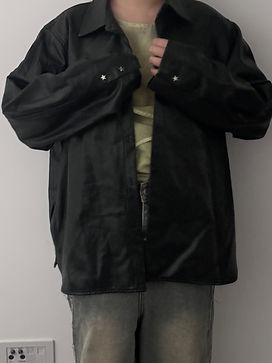
I wore the finished garments and put on a protective outer layer, then walked outdoors for an hour to test the effectiveness of the light protection.


On the day when the UV index peaked at 3, I tested the exposure effects of the standard cyanotype solution and the one with added gelatin, both within a 20-minute exposure time. This allowed me to assess how the cyanotype solution reacted under specific sunlight conditions.
Since it was late autumn and sunny days in London were rare, I needed to assess whether the UV index on that day would allow for effective cyanotype exposure within 20 minutes. To ensure success during actual shoots, I conducted experiments to evaluate exposure levels under different UV indices, which helped me mitigate the impact of weather factors.


In Unit 2, I faced a frustrating preservation issue. No matter how I protected the finished garments from light, they would turn gray by the next day instead of retaining their normal yellow-green color. I needed to resolve this problem, as I couldn't make the garments and shoot on the same day without wasting too much time. After testing various preservation methods, I discovered that storing the finished garments in the refrigerator effectively prevented discoloration.
Experimental process
During the formal experiment, I selected various everyday scenarios with a degree of randomness, aiming to test how different environments influenced the experience of hugging. These included bustling streets, quiet parks, and busy walkways etc. However, there were limitations; the need for exposure meant I couldn't test in more intimate spaces and had to focus on sunny outdoor locations. This is an area I hope to address and explore in future experiments.


Before the hugs began, I did not set any specific rules. I informed the participants that they were free to do anything they wished during the embrace and could terminate it at any time. After each hug, I took the time to document my thoughts and feelings about the experience. This reflective process allowed me to capture the emotional nuances and dynamics of the interactions,
The first participant was a girl. I found myself gently patting her back, and since she was taller, I felt her head resting on my shoulder, which required me to tilt my head back to reach her. I could sense her breathing, and at one point, I noticed her body slightly trembling, accompanied by the sound of her swallowing and breathing. We supported each other, occasionally shifting who was bearing more weight. Eventually, my calves grew sore and began to tremble. During the hug, we had a brief conversation. She was curious about why I was conducting such an embrace experiment, and I explained my thoughts to her.
The second participant was a male, and since we both shared Asian backgrounds, cultural influences made our hug somewhat distant, with his hands hovering politely. We conversed comfortably in our shared language, but I sensed his nervousness as he sought topics to discuss. I could feel the vibrations in his chest as he spoke. The embrace felt more natural without visual contact, which helped avoid the awkwardness of unfamiliar conversation and allowed for a more genuine expression of feelings. During this time, light rain began to fall, leaving water spots on my dress.
The third participant was a tall male who hugged me very tightly. I could sense his breathing, and he rested his chin on my shoulder, allowing me to feel the vibrations when he spoke. We remained silent throughout the embrace, and I noticed his chest rising and falling with each breath. At the end, he mentioned that he had wanted to sing during the hug but didn’t know why he hadn’t done so. However, I could feel his emotions clearly in that moment.
The fourth participant resembled my sister, which immediately gave me a sense of closeness. I felt her body rising and falling with each breath, and her slow breathing helped me become increasingly calm. With our ears pressed together, I tried to engage her in conversation, but she replied briefly, revealing her more reserved nature. I felt a strong sense of safety and found myself relaxing to the point where I could have easily fallen asleep.
The fifth participant and I had a casual conversation, flowing in a somewhat disjointed manner. She wore beautiful earrings, and I noticed how the sunlight refracted through them, casting a stunning diamond shape on my dress.
The sixth participant was a shy girl, and we hardly spoke as we embraced quietly in the bright sunlight. The warmth of the sun made my skin feel hot, while her embrace was gentle, and her voice was soft. We stood in a children's playground, where I observed kids running around, curious about our interaction. The sunlight was so bright that I could barely keep my eyes open, yet I felt a profound sense of happiness and safety in that moment.
As I reviewed the videos documenting all the experiments, I was surprised to notice that I instinctively patted or stroked the backs of the participants during almost every embrace. I reflected on why this happened; it wasn’t a planned action but a natural response. I believe this subconscious behavior was my way of conveying comfort and reassurance. Additionally, I occasionally felt a gentle swaying during the hugs, reminiscent of being in a cradle, which brought about a sense of calm and healing, almost lulling me to sleep.
I also gathered the participants' feelings after the hugs, and the keywords that emerged were peace, healing, and happiness. I was surprised to find that nearly everyone's responses closely mirrored my own feelings during the embraces. This suggested that the twenty-minute duration allowed us to build a kind of mutual understanding; at least in that moment, our emotional experiences were shared, enabling us to perceive each other's feelings more deeply.